
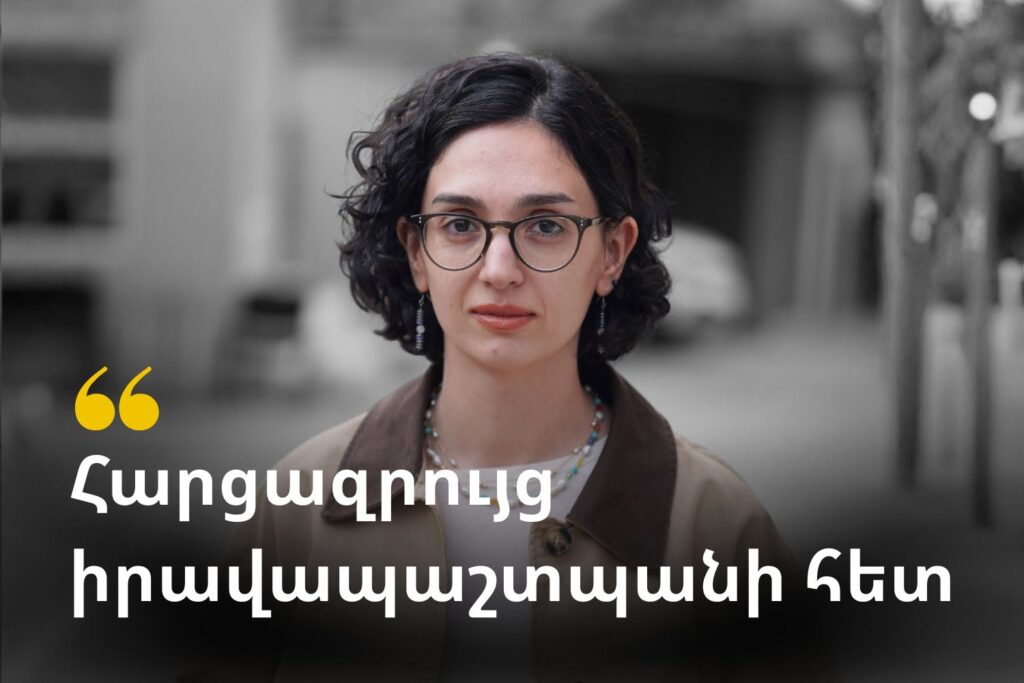
Human Rights House Yerevan presents an interview with a human rights defender. The fourth interviewee is Arpi Manusyan, President of Socioscope.
1. What is your organization’s mission, and what are its main areas of work?
I am from Socioscope, a research organization founded in 2008 by women social scientists. From the outset, our organization’s primary mission has been to provide knowledge to civil society representatives, human rights defenders, human rights professionals, leaders, and researchers.
Our main goal has been to provide civil society with in-depth knowledge on various issues addressed by civil society organizations and individuals. In the classical sense, we are not a human rights organization in that we do not engage directly in human rights advocacy or legal representation. However, civil society and human rights have consistently been among the central themes of our work.
Our key areas of work include the rights of LGBTQ+ people, gender issues, the rights of vulnerable groups, and research on these topics.
Over the years, our organization has gone through several stages of development. In recent years, particularly since 2017, our primary mission and vision have been to foster critical social science thinking in Armenia through research, translations, and educational initiatives.
Our main research and educational areas cover topics such as human rights, the rights of vulnerable groups, the transformation of civil society and activism, gender and sexuality, peace and war, and issues of social justice. We also examine dominant ideas and narratives surrounding concepts such as nation, culture, and history—in other words, the forms of knowledge that shape our understanding of these concepts.
Another important thematic area for us is the study of the relationship between individuals and the public sphere. In general, we are interested in how individual dignity, the public interest, and the concept of the common good are interconnected in Armenia.
We primarily conduct in-depth qualitative research and publish books, articles, and multimedia materials. We also translate research texts, mainly from English into Armenian, covering the aforementioned thematic areas.
Our website features dedicated sections for different topics. We have also published collections exploring the relationship between individuals and the public sphere, incorporating perspectives from sociology, cultural studies, philosophy, and other disciplines.
The third component of our work consists of educational initiatives. In recent years, due to various factors, including limited financial and human resources, we have not been able to implement these initiatives as actively. Nevertheless, we have carried out several highly effective and successful programs, including initiatives on militarization for activists and a critical thinking school project.
We are now considering restarting our educational programs.
2. What significance does Human Rights House Yerevan have for your organization, and why is it important for human rights defenders?
We are one of the founding member organizations of Human Rights House Yerevan. In other words, we were there at the very beginning of its establishment. Before it became Human Rights House Yerevan, it was known as the Human Rights Focus Network and had not yet been officially registered. We were actively involved in building the network from its earliest stages.
At that time, our primary goal and vision were to support human rights defenders by providing them with research-based knowledge. For this reason, Human Rights House Yerevan is very important to us in several respects.
First, all the organizations brought together under its roof are close partners of ours in terms of shared ideas and values. I can say that we have collaborated with every current member organization at different points over the years. For example, we have conducted research in cooperation with Pink Armenia, the Women’s Resource Center, and Real World, Real People. We have also carried out research on sexuality, as well as on gender and sexuality issues. We have worked with the Sexual Assault Crisis Center, too.
Overall, I can say that we maintain very close partnerships with all these organizations. It is particularly important to us that our research also serves as a key foundation for their advocacy work, enabling them to address issues and present them to decision-makers based on research findings.
On the other hand, Human Rights House Yerevan is also important to us as a physical space where we can discuss various issues and develop ideas together. For example, when political developments or other significant events take place, or during periods when intense smear campaigns have targeted organizations, individual members, or human rights defenders, Human Rights House Yerevan has served as a safe environment for us—and, I believe, for the other organizations as well—to discuss the situation, develop strategies, and coordinate our responses.
One of our main contributions to Human Rights House Yerevan is that we consistently bring a research perspective, providing data and analysis on issues of public concern. I believe this is also very important for civil society organizations, as it helps them maintain their connections with different groups in society.
To answer the final question—why is Human Rights House Yerevan important for human rights defenders?—I believe the primary reason is that its central mission is to protect human rights defenders. This is the core focus of its work.
Human Rights House Yerevan and all the organizations working there are consistently involved in documenting violations of human rights defenders’ rights, cases of persecution, and criminal proceedings against them. By human rights defenders, I also mean environmental activists, journalists, and other activists who advocate for various causes.
Documenting these violations, consistently following court proceedings, conducting trial monitoring when human rights defenders, activists, or journalists become involved in legal cases, and preparing regular reports on human rights defenders are all essential activities. In this regard, human rights defenders know that there is an institution that can take these issues forward, as this falls within its core mandate.
For example, in strategic lawsuits against public participation (SLAPPs), corporations, government bodies, or other organizations may file lawsuits against human rights defenders, activists, or journalists in an attempt to exhaust their resources, silence them, or intimidate them. Human Rights House Yerevan consistently monitors and responds to these proceedings.
The same applies to supporting environmental activists and journalists—this is one of the organization’s main areas of work. There may be other organizations in Armenia that also address these issues, but I believe Human Rights House Yerevan is particularly active in this area, with a systematic approach and a specific mandate dedicated to this work.
Beyond its work in Armenia, Human Rights House Yerevan is also actively involved in international advocacy. When hearings take place at international platforms and institutions, including the Organization for Security and Co-operation in Europe (OSCE), the United Nations (UN), and other bodies, we also contribute to the preparation of shadow reports.
Human Rights House Yerevan enjoys a high level of credibility internationally, and our facts and analyses are often used to present the situation and context in Armenia. We also raise concerns about the protection of human rights defenders at the international level, present the existing situation, and regularly seek to contribute to the development of legislative changes aimed at strengthening their protection.
3. In your opinion, which area of human rights protection in Armenia today requires the most attention and change?
I believe that, overall, the human rights protection sector still requires significant reforms. Moreover, given that the human rights agenda does not always take priority amid current political developments, I believe the first step should be to consistently emphasize the importance of human rights.
Human rights issues are often pushed into the background because of security, peace, economic concerns, or other priorities. However, the situation remains particularly challenging for certain vulnerable groups in terms of human rights protection.
These include LGBTQ+ people. Although some legislative reforms have been introduced in the area of domestic violence, numerous problems remain in practice, particularly in law enforcement.
At the same time, an anti-discrimination law has yet to be adopted, despite expectations that it would already have been enacted as part of Armenia’s European integration process. I believe it is essential to explicitly prohibit discrimination on various grounds, including sexual orientation and gender identity, and to ensure that people are protected by law.
Overall, I would say that the more vulnerable a group is, the weaker its protection tends to be. This is also due to negative social attitudes, homophobia, and discriminatory discourse, which continuously contribute to the spread of hostility toward these individuals.
I believe that change is needed not only at the legislative level but also in terms of social culture and public perceptions.
4. Is there any research finding or discovery that genuinely surprised you—something you did not expect to find in the data?
I think almost all of our research continually surprises us. During the research process, you always have certain expectations about the findings you will arrive at, but reality often reveals a completely different picture. This is one of the most interesting aspects of research.
For example, we conducted a study on the gender dimensions of work. We also carried out in-depth interviews with women in highly vulnerable situations. Through this process, you come to see firsthand just how strong women are.
When you meet, for instance, single mothers, women with disabilities, or women caring for children with disabilities, you see the remarkable resilience they demonstrate. You see how they manage to withstand difficulties while continuing to work, create, and find small moments of joy or sources of support amid these challenges.
This was truly impressive for us as researchers. We witnessed how Armenian women, who spend almost 18 out of every 24 hours simply struggling to survive, still manage to create a safe space for their children, provide them with basic necessities, and, at the same time, try to find small moments of happiness.
We were also deeply impressed by the fact that these women do not see themselves solely as victims of their circumstances. They also see themselves as active agents capable of changing their own lives.
Another example comes from our most recent research on young people. There is a widespread perception that young people are apathetic, uninterested in politics, and so on. We entered the research field with this same assumption, but we uncovered some very interesting mechanisms and ways of understanding the issue.
In particular, we realized that what we were seeing was less about apathy and more about alienation. Young people are, in fact, very interested in what is happening around them, but they consciously maintain a certain distance because they generally lack trust in political processes.
This research was also important to us because it allowed us to propose new concepts and develop new language to describe these phenomena. Saying that “young people are apathetic” conveys one meaning. However, describing the issue as alienation from institutions and a lack of trust, rather than apathy, presents an entirely different picture and offers a different explanation.
5. What personally led you to research as a means of achieving social change? Why did you choose research rather than direct human rights advocacy?
If we are talking about the organization, its founders were researchers themselves: three women who shared a background in sociology and research experience. This was the field in which they had the most expertise.
As you rightly pointed out, research can be a tool for social change. We do not believe that it is possible to conduct research that is entirely impartial or neutral. It is always important to understand the perspective from which you are examining an issue, what your objective is, and to be transparent about it. For this reason, we consider research an important means of promoting social change and strengthening democracy.
There are very few specialized research organizations of this kind in Armenia, particularly those that study specific topics consistently and over the long term. I believe this has also played a role in our choice.
Most of our organization’s members are researchers, and we believe that the continuous critical examination of issues, their analysis, and the dissemination of research findings are important ways to bring about change. Of course, research alone is not enough; it must be accompanied by activism and human rights advocacy.
In this regard, Human Rights House Yerevan is a particularly interesting platform because it brings together organizations with different areas of expertise, including research, cultural rights, the protection of vulnerable groups, and other fields. In this way, each organization contributes its own experience and professional knowledge, and these efforts come together in pursuit of a common goal.
6. What has been your greatest achievement as a human rights defender, and what issue still requires the most work to address?
I believe that the area requiring the most work is still the protection of human rights defenders. Mechanisms need to be established to ensure that human rights defenders are protected and have effective legal tools to defend themselves.
At the same time, it is important to change public discourse, which often seeks to delegitimize human rights work and stigmatize human rights defenders or activists, for example, by labeling them as “grant-eaters.” I believe this is a particularly important issue that still needs to be addressed.
As for achievements, I would especially like to recognize the work of women human rights defenders, who over the years have managed to significantly change public perceptions of women’s rights, domestic violence, sexual violence, harassment, and various related issues. They have succeeded in raising public awareness and advancing the women’s rights agenda.
As researchers, we can see this very clearly. When we studied domestic violence years ago and compare that with how we discuss the same issues today, including those related to sexual violence, it is evident how much social change has taken place. Today, women are much better informed, less willing to tolerate violence against them, and more likely to speak out about these issues.
I believe this is one of the important achievements we can truly be proud of.
- October 13, 2026
- Posted by: Alex Taroyan
- Category: Reports
