
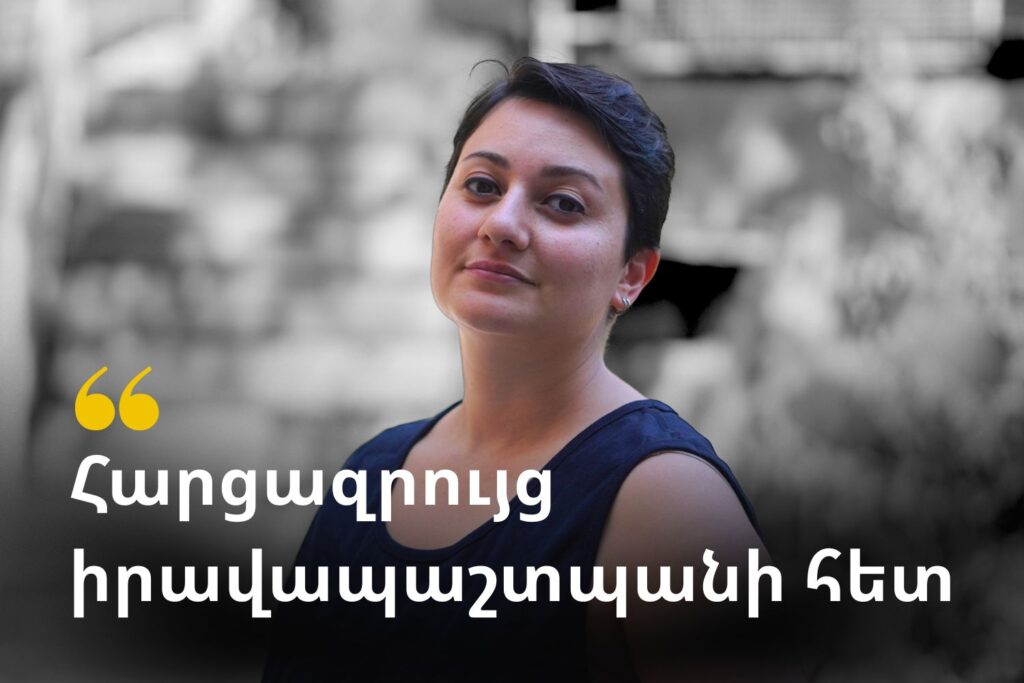
Human Rights House Yerevan is conducting a series of interviews with human rights defenders. The second interviewee is Karine Aghajanyan, President of Pink Human Rights NGO.
1. What is your organization’s mission, and what are the main areas you work in?
Pink’s mission is to empower LGBT+ people (lesbian, gay, bisexual, trans, and people with other sexual orientations or gender identities), improve their well-being, protect their human rights, and contribute to building a society free from discrimination.
It is difficult to describe in just a few sentences the enormous amount of work we do as an 18-year-old organization with extensive experience and expertise in this field. Nevertheless, I am proud to say that we provide sensitive and professional support services, including social worker consultations, legal consultations, and legal representation to LGBT+ people whose rights have been violated on the basis of their sexual orientation or gender identity.
At the same time, we advocate for legislative reforms aimed at introducing effective anti-discrimination legal mechanisms.The organization also provides specialized psychological support, helping community members overcome internalized homophobia, stress, and anxiety.
We also facilitate support groups for LGBT+ people, as well as their family members and relatives. We organize trainings, seminars, and awareness-raising campaigns aimed at increasing public knowledge about LGBT+ issues, challenging stereotypes, and fostering an atmosphere of empathy.
We also work with various professional groups, including journalists, lawyers, and psychologists, to develop skills for working with the community in a sensitive and ethical manner.We create safe spaces for community self-organization, cultural and social events, and promote cooperation with other local and international human rights organizations.
2. What significance does Human Rights House have for your organization, and why is it important for human rights defenders?
Pink is one of the founding members of the Human Rights House Yerevan. In fact, over the years, we have invested consistent work and significant effort into establishing this cooperation and founding the Human Rights House in Armenia.Today, it is extremely gratifying to see that this long-term work has yielded results, and that we now have a physical space—the building—which will serve, so to speak, as a home for human rights defenders.
It is a space where human rights organizations and individuals working in different areas come together.It provides an opportunity to strengthen connections, exchange experiences, and undertake joint initiatives. Human rights work is often accompanied by various challenges and pressures. The Human Rights House becomes a safe environment where people can receive support from partners, experience mutual solidarity, and feel more protected.This model allows for more effective use of available resources and strengthens our joint advocacy efforts.
3. In your opinion, which area of human rights protection in Armenia today requires the most attention and change?
Of course, human rights are indivisible, and all areas are equally important. However, as a human rights defender, I would identify three pillars in Armenia today that require the most urgent attention and systemic change.
Of course, these areas are interconnected and form the foundation of any state governed by the rule of law. The first is justice, because it is the foundation without which the protection of all other rights becomes impossible. If a country does not have independent, impartial, and fair courts, then any violation of rights remains unpunished, and citizens lose their sense of security and protection.
The second is education. Throughout our years of work, we have observed that at the root of almost all types of human rights violations, hate speech, and intolerance are lack of education, lack of knowledge, deeply rooted stereotypes, and myths. Only through quality, inclusive, and people-centered education is it possible to build compassionate and informed citizens, as well as a society that respects the rights of others. This applies both to schools and universities.
And finally, democracy. I can confidently say that today in Armenia we have that small but long-awaited seed of democracy, which is still extremely fragile. We must protect this democracy at all costs, because without it, it is impossible to imagine either an independent and fair justice system or the education of citizens who are aware of their rights.
4. How do you relax and recharge outside of work? What helps you maintain your inner balance?
I’ll be honest: completely disconnecting from the work I do is almost impossible, and I would be lying if I said that I always manage to switch off easily. However, at Pink, we have put clear institutional mechanisms in place to help the team recover its energy and reduce professional burnout.
We provide psychological support for our employees to help them address both professional and personal challenges. We organize team retreats and try to reduce the workload during working days as much as possible.
My main source of maintaining inner balance and restoring my energy is my family. Spending time with my partner, going for walks and playing with my little one bring me back to the present moment. Moreover, it is precisely when I am with my child that I most deeply understand the importance of my work and activism, because I realize that the equal, safe, and free society we are trying to build through our work is ultimately for their future and the future of their generation.
For physical rest and recharging, the best thing for me is taking a vacation and traveling.
At the same time, I get a lot of energy from going to different places with my teammates outside of work. From the outside, it might seem that my entire life revolves only around work and my colleagues, and, to a large extent, that is true. Working at Pink is a unique experience where your teammates are also your friends and people who share your commitment to the same cause. That was not the case in my previous workplaces, and it is precisely this sense of solidarity within the team that allows me not to burn out and to keep moving forward.
5. Many people see injustice and are concerned about it, but not everyone takes action. In your opinion, what motivated you not only to recognize the problem, but also to decide to work in human rights advocacy?
Honestly, it is difficult to point to one specific reason. I think it is a result of who I am and the path I have taken. My school years, for example, were quite difficult, as I personally experienced bullying. Seeing how unfair the world can be and feeling that there was no one by my side at that time to protect me, I decided to become that person myself.
I grew and became stronger so that I could help and stand by more vulnerable people today. As a member of the LGBT+ community, I have experienced firsthand what it means to feel completely alone, rejected, and unprotected by society. I firmly believe that no one should have to go through that pain or feel so alone.
I want to help everyone I can. For me, this is the main purpose of life. People should support and stand by one another. Life is too short to waste it on meaningless things, hatred, or indifference.
6. As of 2026, Armenia still does not have a legal act that explicitly recognizes sexual orientation or gender identity as protected characteristics. In your opinion, what is the main reason this gap still persists? And is there any specific legal reform that you believe would be realistic to advance today?
The main reason this legal gap persists is, first and foremost, the lack of sufficient political will on the part of the authorities.
Our monitoring and daily observations show how LGBT+ issues are regularly and deliberately manipulated by various political forces and figures to advance their own political interests and gain political capital.
Often, simply labeling or accusing someone of supporting LGBT+ rights is enough to divert public attention away from the country’s most important issues. As long as an atmosphere of fear and anxiety is artificially maintained in society, many decision-makers, even if they personally do not see an issue with these matters, prefer to stay away from the topic in order to avoid the risks of political manipulation.
Another important factor is the profound lack of literacy and basic knowledge in our society regarding sexuality and gender-related issues.
As for realistic legal reforms, the most urgent and necessary step today would be the adoption of a specific law in which “sexual orientation” and “gender identity” are explicitly and directly recognized as protected characteristics.
A comprehensive anti-discrimination law should be adopted, defining discrimination and its forms, establishing procedural mechanisms for examining cases of discrimination, and providing an extensive list of protected characteristics, including sexual orientation and gender identity. We need to stop avoiding clear terminology and call things by their proper names.
Simply leaving a general phrase such as “other social groups” in the law does not allow for full access to justice, as it can lead to differing interpretations in legal practice. These concepts must be explicitly enshrined in the law and legally defined so that community members can effectively defend their rights in courts and other institutions by relying on the law, while we, in turn, can support them by ensuring their representation before the courts and the police.
7. What has been your greatest achievement as a human rights defender, and what is the issue that still requires the most work to resolve?
As a human rights defender, I consider the greatest achievement of my team and me to be the fact that, through years of consistent, difficult, and often challenging work, we have managed to break the absolute silence. I remember that before the age of modern technology, LGBT+ people and the issues affecting them were hardly discussed anywhere.
We have empowered community members and created safe spaces and platforms where LGBT+ people no longer have to hide or feel completely alone. The fact that today we can speak openly, honestly, and publicly about these issues is already a major step forward for our society.
Another major achievement is the establishment and development of Human Rights House in Armenia. It is the tangible result of years of collective effort, which today brings the human rights community together and will certainly continue to expand its network over the years.
As for the issue that still requires the most work to resolve, I would say it is overcoming public perceptions, deeply rooted stereotypes, and hate speech.
Changing legal acts, although difficult, is possible. But changing people’s mindsets and fostering empathy and respect requires decades of hard work and education. As long as discrimination and intolerance persist in society, and as long as there are no clear anti-discrimination legal mechanisms at the state level, we still have a great deal of work ahead of us.
- September 29, 2026
- Posted by: Alex Taroyan
- Categories:
