
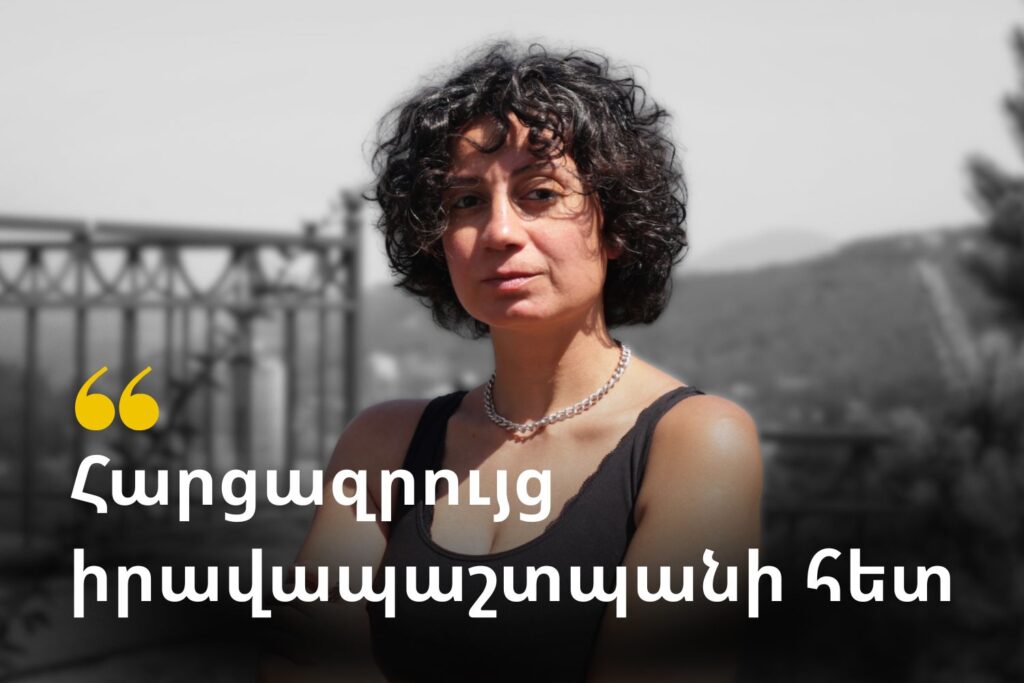
Human Rights House Yerevan is conducting a series of interviews with human rights defenders. The first participant is Anush Poghosyan, Executive Director of the Women’s Resource Center.
1. What is your organization’s mission, and what are the main areas you work in?
Our organization was founded in 2003 and works in the field of women’s rights.
The Women’s Resource Center leads a collective struggle to challenge and transform patriarchal systems in Armenia.
Through empowerment, advocacy, and solidarity, we:
• Support and strengthen diverse groups of women and adolescent girls;
• Identify, resist, and disrupt cultural, structural, and systemic forms of oppression and discrimination;
• Promote behavioral, social, and political transformative changes that advance gender justice and equality.
Our collective struggle also includes LGBTIQ+ people, marginalized communities, and all those who share our values of justice, inclusion, and liberation.
Through its work, the Women’s Resource Center strives to bring about behavioral and normative change in society by influencing public policy, socio-cultural, and legislative spheres.
The Women’s Resource Center operates across three main thematic areas:
• Feminist safe space and empowerment of women and girls
• Sexual and reproductive health and rights
• Advocacy for women’s rights
2. What significance does Human Rights House have for your organization, and why is it important for human rights defenders?
Human Rights House is not simply a platform for work or cooperation for the Women’s Resource Center NGO.
As a founding member, we see it as a space for solidarity, mutual support, and joint action to protect human rights.
It provides an opportunity to bring together the experience and resources of different human rights organizations, respond quickly to human rights violations, and create a safe environment for human rights defenders to carry out their work.
For human rights defenders, Human Rights House is important because it promotes cooperation, the exchange of knowledge and experience, capacity building, and the strengthening of international connections.
Especially in an environment where human rights defenders often face pressure, targeting, or professional isolation, Human Rights House provides an important platform for solidarity and protection.
By working together, we are better able to protect human rights and contribute to strengthening democratic values in Armenia.
3. In your opinion, which area of human rights protection in Armenia today requires the most attention and change?
I believe that preventing violence against women and ensuring gender equality require the greatest attention today.
Although there has been some progress in recent years, it is still necessary not only to improve legislation, but also to ensure its effective implementation and change societal attitudes.
4. Your organization not only supports women but also works toward legislative changes and public awareness. Which is more difficult: changing the law or changing society’s attitudes?
Changing society’s attitudes is more difficult.
A law can be adopted, but if stereotypes and a culture of victim-blaming persist, even the best laws cannot be fully effective.
That is why the Women’s Resource Center works simultaneously on both legislative reforms and raising public awareness.
5. What is the most common stereotype about women’s rights today that, in your opinion, continues to hinder achieving equality in Armenia?
One of the most common stereotypes is that protecting women’s rights is about giving women special privileges.
In reality, it is about equal opportunities and the right to live free from discrimination and violence.
6. If you had to highlight one provision of the Istanbul Convention whose full implementation could have the greatest impact in Armenia, which would it be and why?
I would highlight the state’s due diligence obligation to prevent violence, protect victims, effectively investigate cases, and hold perpetrators accountable.
If this principle were fully implemented, it would significantly strengthen the entire system of protection for women.
7. What has been your greatest achievement as a human rights defender, and what is the issue that still requires the most work to address?
Among our greatest achievements are the legislative changes that we have contributed to developing and advancing, particularly amendments to the Labor Code of the Republic of Armenia concerning sexual harassment, the adoption of legislation on domestic violence, as well as legislative reforms concerning reproductive rights.
However, the greatest challenge remains ensuring the effective implementation of these laws and overcoming gender stereotypes, because sustainable change begins not only with legislation, but also with changing mindsets.
- September 29, 2026
- Posted by: Alex Taroyan
- Category: Reports
